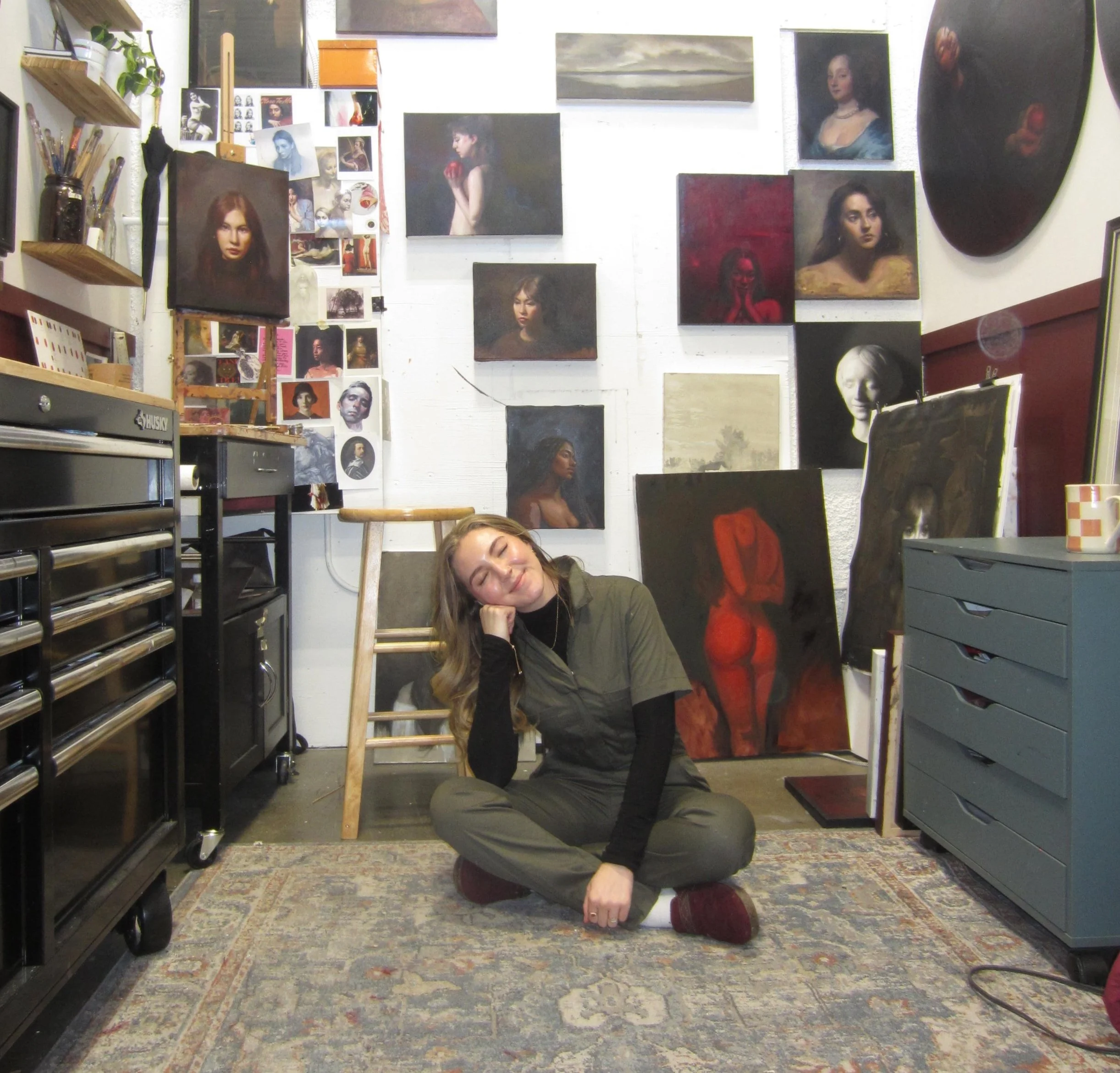
ALYSSA SKILNICK

Alyssa Skilnick is a contemporary realist artist based in Calgary, Alberta, and a member of the 500 Collective. She previously studied at the Florence Academy of Art in both New York and Florence. The primary mediums used within her practice include; oil, charcoal and gouache. Her work is highly influenced from her classical atelier training that have allowed her to approach her work with an intentional degree of realism that draws viewers in to create a deeper dialogue.

Her work focuses on the figure, portraiture and landscape as she explores women's health and systemic neglect in the healthcare system often overlooked diseases such as endometriosis. The majority of Skilnick’s models connect to the topic, creating a visual archive that acts as a catalyst of connection, validation, understanding and hopefully a push forward in terms of systemic change.
Interview:

Since graduating from such a classical and structured atelier program have you noticed an adjustment period of having to find your voice as an artist?

What have been the biggest challenge you’ve faced during that process?

“I guess the answer is, Yes! When you're in school you're focused on the technical skills and fundamentals and once you're outside of school, you begin thinking of yourself in a different context. You start questioning what art you want to do, what you like to see and what to keep or abandon from your education. 

A challenge I have faced since graduating is training myself to constructively critique my work the way my teachers would in order to guide me and help me grow. I’m always thinking about how I can push myself in the way my teachers did because that's when I saw the most growth in myself as an artist. It's a difficult and challenging transition from the structured atelier to your own personal practice.”

 Your work expresses a strong understanding of both contemporary art, classical realism and the larger art historical canon with the use of references. Can you expand on how this combination of contemporary modern art and classical realism interconnected within the development of your technique and practice?

“They usually say art is created from art. So I allow myself the liberty to take from other artists that I admire and appreciate into my work, whether it's good design, colour palette or light effect. When you're working with elements of your favourite artists from the past and integrating it with your work, you're combining past and present to create an interesting dialogue and pay homage to those that came before you. It’s cool to be innovating in your practice but it’s more interesting in my opinion to combine past elements with the new.”

Do you ever find it necessary to break from tradition in your work to achieve a specific narrative or atmosphere? For example, have you ever abandoned a particular technique or disrupted compositional structure to enhance the final outcome? What factors influence these decisions?

“Yes, I do feel like I have to break the rules from tradition because I’m looking to express a realness, rawness and eeriness in my work that is not achievable otherwise. The artists I look to for inspiration for this real, raw and eerie feeling in their work are also breaking the rules. I’m still discovering what I want to keep and what to break in my practice. It's a process that I’m continuing to develop post atelier training.

It's difficult sometimes with the realization that what i’m doing isn’t what my teachers would approve of when I looked to them for approval for so long. Considering this though, the point of the paintings is to tell a story not portray perfect technique. I like having things look non-perfected with a quirk to it. For example, if you look at Jenny Sevilles works, they are not technically super anatomically correct but there is a raw and interesting realness that exudes off the work. It’s a hard thing to achieve.”

Can you walk us through your process when starting a new series or painting? How do you approach planning–do you begin with a theme and develop the visuals from there, or does the imagery come first?

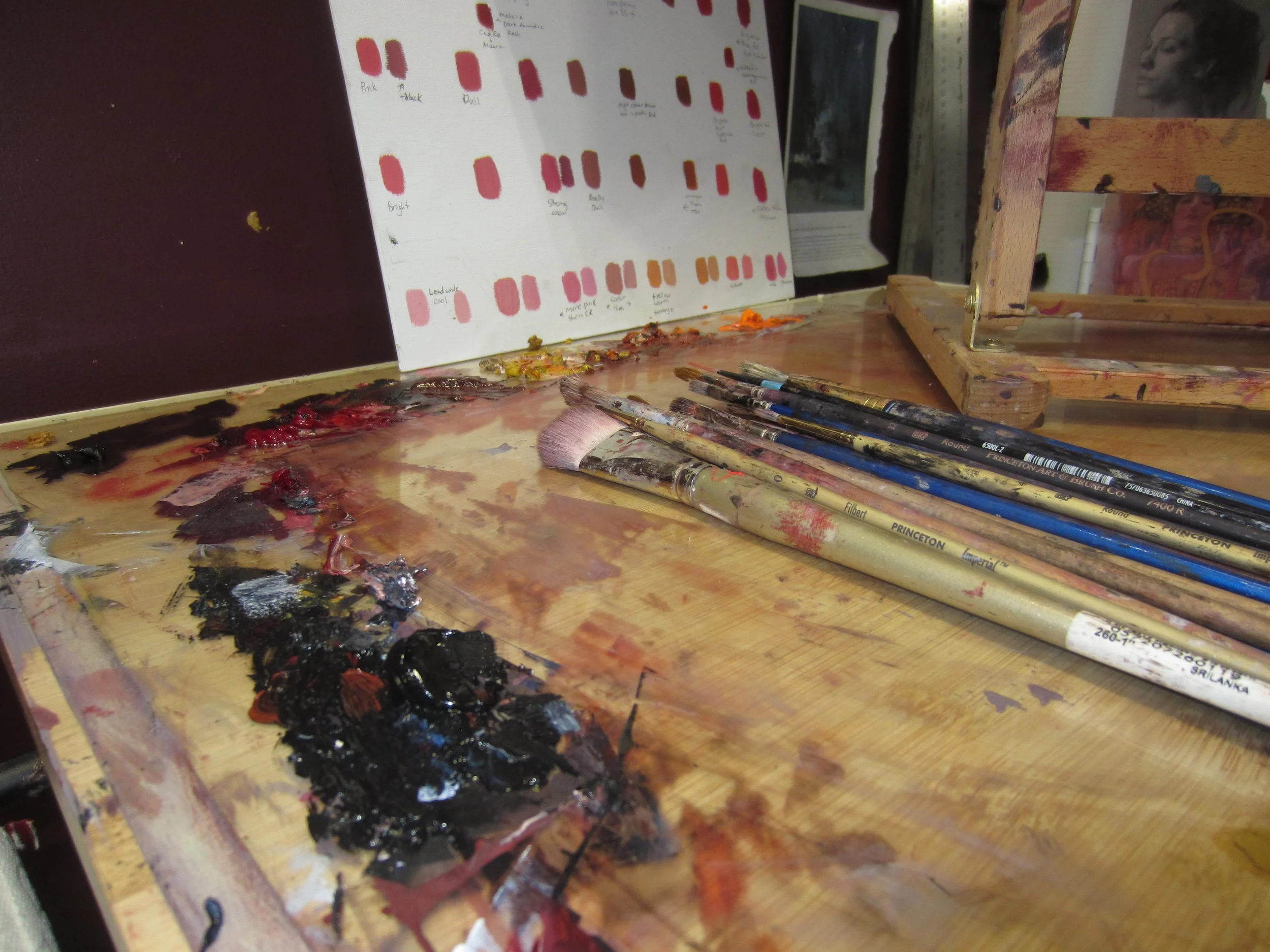
“I start off thinking about what’s important to me and that's what I'll paint. I usually see a concept in my head and with that imagery I develop it more, firstly with sketching it out, taking reference photos, creating colour studies and by the finished product the work changes so much from the original idea. 

Sometimes I get stuck in my head throughout the process thinking about how silly being an artist can be when there are doctors, for example, out there really helping people. So, through my art, I like to have some sense of advocacy or sense of purpose. Art is a way to communicate your beliefs and inner workings so that's what I’m thinking about during the initial phase of starting a series or new work.”

Additionally, what influences outside of the traditional art field shape your practice?

“Songs and movies influence me a lot. But particularly the songs and movies that make people uncomfortable or confront feelings you’ve never felt or acknowledged before. When you hear a song and the narrative isn’t relatable but you can feel the emotion behind it, I want my work to feel like that.

With movies, when there's a crazy scene or a super quiet scene full of background music and beautiful imagery and a deep emotional feeling to it, that inspires me in my work. It’s less about the narratives inspiring me but more about the in-between feelings within the scenes. I like movie endings that are “terrible” or are not a happy ending because they are actually real, no ending should make you feel good because that's not reality.”

The theme of women's health, specifically endometriosis and systemic neglect play a huge role in the narratives embedded in the visuals of your work.

Do you ever struggle with vulnerability with a topic that is so close to home?

What motivates you to push past that and continue to pursue your goal of advocating for women's health through your practice? 

“Sometimes I do, because it is very vulnerable and you’re putting yourself out there with a taboo topic, it makes people uncomfortable but that’s what I'm leaning into and trying to enjoy. It’s one of my goals but even thinking about it feels vulnerable, but at the end of the day I remember I’m creating and putting this all out there for more than myself.

I want people to connect and feel the intimate nature of the imagery. I think I worry there's not a market for work like that but when I look at other artists who are also working with vulnerable topics, they are being so truthful and so real. For example, Jenny Seville or Käthe Kollowitz, have huge popularity and sell high on the market and they make their work look so effortlessly real, it motivates me to keep going.

If I'm even one ounce as real as them then I’ll be happy with my work. People focus on the art market and demand more than looking within themselves. The latter is what will last longer because it's real and true, people will connect with it longer, otherwise your work may be empty. I’m not creating work for quick gratification or to make money, I know I'm working within a niche but I think it’s important and worth while.”

What is one personal goal and one professional goal you have for the next year?

“One personal goal I have over the next year is to lean into trusting myself more and being confident in my decision making. This will come with time, experience and lots of experimenting in my practice. I'm trying to figure it out so being more confident would be huge and add so much to my work.

One professional goal I have over the next year is to get my series in an exhibition. I’ve put so much heart and soul into the series over the last year so being able to show it and have it connect to viewers would be amazing. I want to continue to advocate for women's health and educate people on it through my practice, that way my work will have more purpose.”

With the deep emotional resonance of your work, what impact do you hope it has on viewers as they engage with it?

“I hope people are intrigued and want to know more and that they might be questioning that maybe they weren’t aware or didn't understand something, just because they haven't been confronted with it before.I hope it helps viewers to feel seen but also for viewers to hold more empathy.”

What does growth as an artist look like for you in terms of becoming a successful artist in your field? How do you measure that success? 

“That’s a hard question. I think about it alot. I don’t think making money is what I would categorize as successful for me. I think success would come in the form of being able to reach people and gain a larger audience.

I don’t like the idea of making money online with TikTok’s or Reels, it feels quick and cheap to me. To me a successful artist is seen and appreciated for their work more than a quick commodity or a popular name. I would want my work to become an investment for people rather than a trend.”

See More Here!